Emergency Scenarios
Bangkok Bar Fire: What Happened, and What It Teaches Malaysian Families About Venue Safety


 Share this Article:
Bangkok Bar Fire: What Happened, and What It Teaches Malaysian Families About Venue Safety
A midnight blaze at a Bangkok music bar killed at least 27–28 people and injured more than 70 others. Here’s what investigators know so far — and the practical lessons for anyone who spends time in crowded venues here in Malaysia.
A fire tore through a popular music bar in Bangkok’s Chatuchak district late Sunday night, July 12, killing at least 27–28 people and injuring more than 70 others, according to Thai authorities. It’s being called the country’s deadliest nightlife venue fire in nearly two decades — since the 2009 Santika Club blaze that killed 67 people.
For Malaysian families, this tragedy sits close to home — geographically, culturally, and in the kind of venues involved. It’s worth understanding exactly what went wrong.
What happened
The fire broke out at the Rong Beer Na Lat Phrao bar, a single-story brewery-restaurant known for live music, at a busy intersection in northern Bangkok near shopping malls and the Chatuchak Weekend Market. A musician performing on stage that night said he saw smoke rise from a circuit breaker near the stage moments before the power cut out. An explosion followed, and thick black smoke filled the venue within minutes.
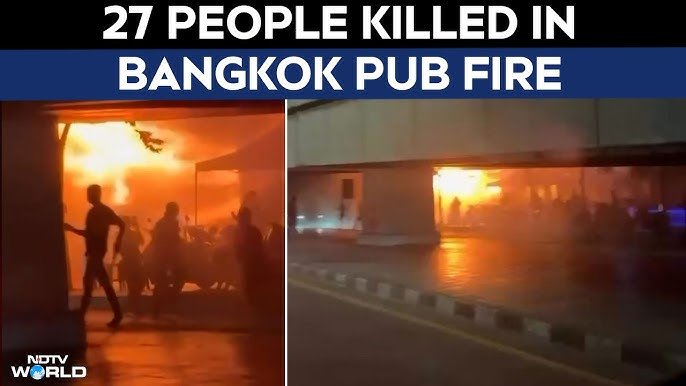
Video from the scene showed flames bursting out of the front entrance as panicked patrons fled, some with their clothing on fire. The blaze was brought under control within roughly 30 minutes, but by then the damage was catastrophic. Bangkok’s governor said most deaths were caused by smoke inhalation rather than burns.
Contributing factors, according to investigators
- Combustible ceiling materials. Photos from earlier this year appear to show plastic decorative plants above the stage, possibly combined with foam soundproofing — a combination that can let flames spread rapidly overhead.
- No sprinkler system. Experts note that even a working sprinkler system may not have stopped a fire spreading fast across a ceiling — sprinklers aren’t designed for that.
- Obstructed and poorly marked exits — a recurring theme in nightlife venue fires worldwide, where furniture, stock, and merchandise routinely narrow escape routes.
- Aging electrical wiring. The building is reportedly around 50 years old, and investigators are examining whether faulty wiring caused the initial electrical fault.
Thailand’s National Police Chief said negligence is currently the leading theory guiding the investigation.
Not an isolated case
This fits a grim, recurring pattern in nightlife venue fires globally — flammable decorations, blocked or locked exits, overcrowding, and inadequate fire suppression:
- 2009 — Santika Club, Bangkok: 67 killed, 200+ injured during a New Year’s Eve celebration.
- 2022 — Mountain B nightclub, Chonburi, Thailand: 25 killed.
- Jan 2026 — Crans-Montana, Switzerland: roughly 40 killed in a ski-resort bar fire.
- July 2026 — Rong Beer Na Lat Phrao, Bangkok: 27–28 killed, 70+ injured.
The recurrence of these incidents, across very different regulatory environments, tells us the failure points are common — and largely preventable.
What this means for your family
When you’re out at a bar, club, or crowded event: spend a few seconds locating at least two exits when you arrive — don’t assume the door you came in through will still be usable. In a fire, smoke inhalation is often more dangerous than the flames themselves: stay low, cover your nose and mouth, and move toward an exit immediately rather than waiting to see how serious it gets.
If you run or manage a venue: never let furniture, stock, or decorations sit in front of emergency exits. Keep exit signage lit and doors functional. Avoid untreated plastic or foam decorative materials near wiring or heat sources, and have your electrical system inspected regularly — especially in older buildings.
What we’re still waiting to learn
Investigations are ongoing, and the full account of what went wrong — mechanically and structurally — will take time to establish. But the early findings echo a familiar and preventable set of failures. For venue owners, regulators, and anyone who spends time in crowded nightlife spaces, this is a sobering reminder that fire safety basics aren’t optional extras.
This article will be updated as more information becomes available from Thai authorities.
Preparedness starts with awareness. Dr. Preppers breaks down real incidents so Malaysian families can spot the same risks before they happen — no fear, just readiness. Explore our Emergency Scenarios guides for more.