Latest News, Survival Skills
Lost in the Malaysian Jungle: Lessons from Jaslinda’s Disappearance at Gunung Batu Putih


 Share this Article:

Lost in the Malaysian Jungle: Lessons from Jaslinda’s Disappearance at Gunung Batu Putih
Jaslinda Saludin was experienced. She reached the summit. Yet she never returned. Her disappearance at Gunung Batu Putih is a sobering reminder that in the Malaysian jungle, experience alone is not enough — preparation is what keeps you alive.
What This Guide Covers
- What happened during the Gunung Batu Putih expedition
- Why experienced hikers can still become lost in Malaysian jungle terrain
- What to do immediately if you realise you are lost
- How to signal rescuers and make yourself easier to find
- The essential hiking survival kit every Malaysian hiker should carry

A Normal Hike Can Turn Into a Survival Emergency Fast
It started like many hiking trips across Malaysia.
A group of hikers. A challenging mountain route. A planned expedition. A summit waiting to be reached.
Then something went wrong.
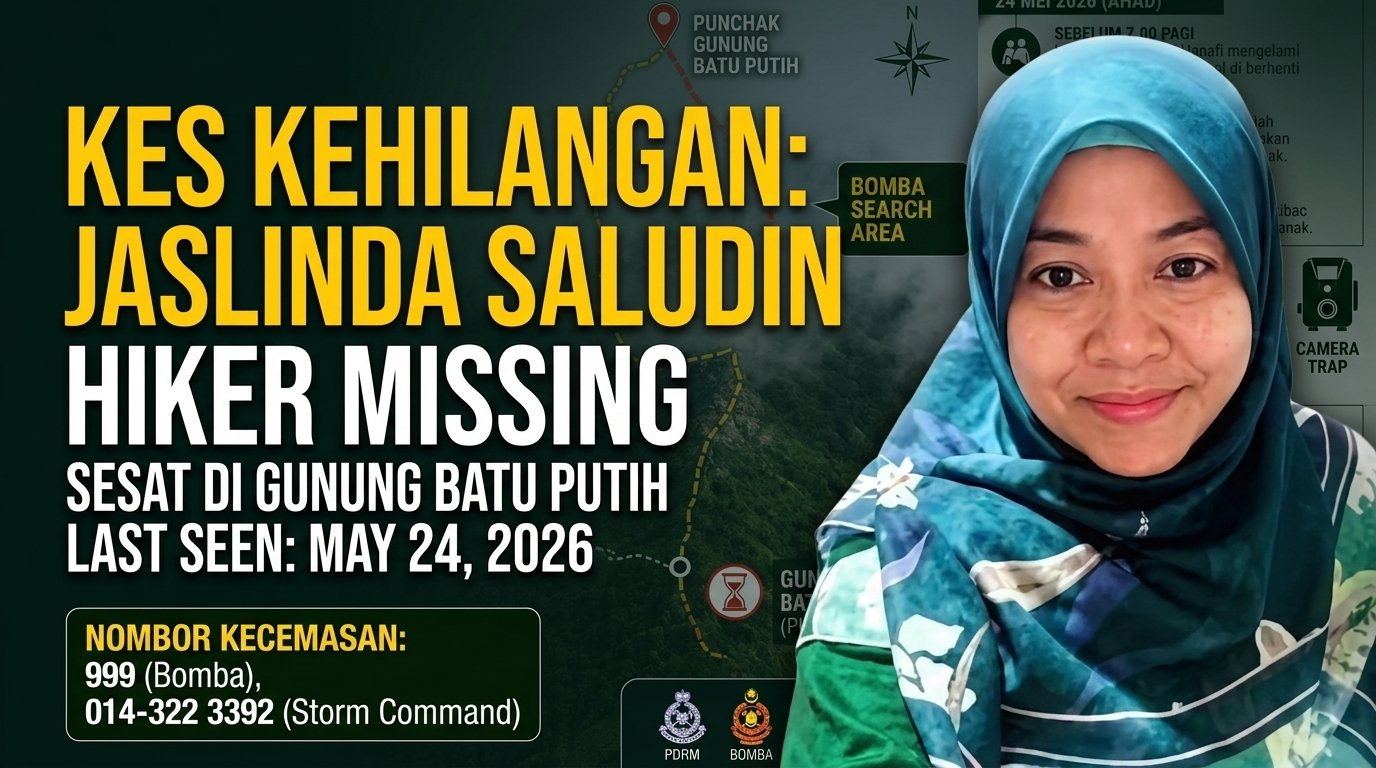
As of June 1, 2026, more than 50 rescue personnel — including STORM team members, Wildlife Department officers, forestry mountain guides and helicopter crews — were combing the dense jungle around Gunung Batu Putih in Tapah, Perak, searching for one person: Jaslinda Saludin, 49.
She went missing on May 24. She was experienced. She reportedly reached the summit.
But she did not come home.
For Malaysian hikers, her case raises a serious question:
If you were lost in the jungle right now, would you know what to do — and would rescuers know how to find you?
Two Big Threats. One Critical Vulnerability.
Malaysia’s jungle is beautiful, but it is also unforgiving. The danger is not always dramatic. Most outdoor emergencies begin with small problems that slowly combine into a crisis.
- A wrong descent route can take you away from the planned trail.
- A dead phone battery removes your main communication tool.
- Poor telco coverage makes emergency calls unreliable.
- Fatigue affects decision-making after long climbs.
- Heavy jungle cover makes aerial searches difficult.
In Jaslinda’s case, one detail became especially important:
Her phone battery had reportedly already died before the critical stage of the hike.
What Happened at Gunung Batu Putih?
Jaslinda Saludin, a 49-year-old clerk from Damansara, Selangor, with nearly 10 years of hiking experience, joined the Trans Spencer Chapman expedition — a challenging multi-day trail in the Perak highlands.
The group consisted of 14 hikers and two Forestry Mountain Guides, travelling through the Pos Gedung – Gunung Bah Gading – Gunung Batu Putih – Kuala Woh route.
During the expedition, health issues reportedly affected some hikers. One male hiker, Mohd Hanafi Neikmad, suffered breathing difficulties and had to stop with a guide.
Jaslinda was last seen by a Forestry Mountain Guide at around 7:30 AM on May 24 while continuing her ascent toward Gunung Batu Putih, which stands at about 2,132 metres.
She later reached the summit. A handwritten message believed to have been left by her was found near the peak.
But reaching the summit is only half the journey.
Many hiking emergencies happen during descent, when fatigue is high, concentration drops and trail junctions become easier to miss.
Why Descent Is Dangerous
After reaching a summit, hikers are often tired, dehydrated and mentally relieved. This is when wrong turns are more likely. On mountains with multiple ridges or unclear trails, one mistaken descent route can send a person far away from the intended exit.
Rescue teams believe Jaslinda may have descended in the wrong direction, possibly toward a more remote route instead of the planned exit toward Kuala Woh.
The search later expanded to areas including Sungai Ayer Busok, Kem Sukaneka and the Gunung Raya corridor. Clues reportedly included a water bottle, supplement packets and trail camera images.
Despite drones, helicopters, STORM personnel, forestry officers and wildlife teams being deployed, thick jungle terrain and poor communications coverage continued to complicate the operation.
Why This Matters to Every Malaysian Hiker
This is not a story about recklessness.
Jaslinda was not a beginner. She was with a guided group. She had hiking experience. She reached the summit.
That is exactly why this case matters.
It shows that experience alone is not protection.
Protection comes from systems:
- A charged phone and backup power
- A group that tracks every member
- A clear descent plan
- Offline navigation
- Signalling tools
- Bright clothing
- A trusted person at home who knows when to raise the alarm
Simple rule: never enter the jungle assuming your experience will save you. Enter with a plan, tools and backup systems.
What To Do If You Get Lost Hiking in Malaysia
The biggest mistake lost hikers make is continuing to walk while panicking. Every step in the wrong direction increases the search area and makes rescue harder.
Step 1: STOP
Use the internationally recognised S.T.O.P. principle.
- S — Stop: Stop walking immediately.
- T — Think: Recall your last known location and route.
- O — Observe: Look for trail markers, streams, footprints, ridges and familiar landmarks.
- P — Plan: Decide calmly before moving again.
Sit down. Breathe slowly. Do not let fear make decisions for you.
Step 2: Signal Immediately
If you still have phone battery and signal:
- Call 999
- Send GPS coordinates to family or hiking group members
- Share your live location on WhatsApp
- Tell someone your last known landmark
- Switch your phone to battery-saving mode
If there is no signal, use non-phone signals:
- Blow a whistle
- Use a torch at night
- Use a reflective surface during daylight
- Create visible ground markers
- Stay near open areas where safe
Step 3: Find Shelter Before Nightfall
The Malaysian jungle becomes much more dangerous at night. Darkness, rain, fatigue, insects and wildlife all become harder to manage.
- Choose higher ground away from flood-prone stream beds
- Avoid unstable slopes and dead branches overhead
- Use a raincoat or poncho as cover
- Keep yourself as dry as possible
- Mark your shelter location clearly
Step 4: Secure Water Carefully
Water is more important than food, especially in Malaysia’s humid climate.
But searching for water can also cause you to move farther away from your last known route.
- Listen for streams before moving
- Mark your shelter before leaving
- Purify water if possible
- Use water purification tablets or a filter if available
- Do not walk far without marking your path
Step 5: Make Yourself Easy to Find
Your job is not to prove you can hike out alone.
Your job is to help rescuers find you.
- Stay in one general area if safe
- Use bright clothing or a bright raincoat
- Create SOS signs using branches or stones
- Stay near clearings, ridge tops or riverbanks when safe
- Blow three whistle blasts regularly
- Leave obvious trail markers if you move
5 Essential Survival Items Every Malaysian Hiker Should Carry
You do not need to carry a heavy expedition bag for every normal hike.
But every Malaysian hiker should carry a small survival kit that solves the most common jungle problems: getting lost, losing communication, being caught after dark, getting wet and needing to signal rescuers.
Wisel / Whistle
A whistle can be heard much farther than shouting and uses far less energy. Three short blasts is a recognised distress signal. This should be inside every hiking bag.
Torch Light With Extra Battery
The jungle becomes extremely dark after sunset. A torch helps prevent falls, supports night signalling and reduces panic. Always carry spare batteries in a waterproof bag.
Small Knife or Machete
Useful for shelter building, cutting cordage, clearing small obstacles and emergency repairs. Carry it safely and use it responsibly.
Bright Colour Raincoat
A bright raincoat protects you from rain and makes you easier to spot. Choose orange, yellow, red or bright blue. Avoid camouflage, black or dark green.
Paracord Rope 10m
Ten metres of paracord weighs very little but can be used for shelter, repairs, markers, securing gear and emergency support.
Dr. Preppers’ Jungle Hiking Checklist
Before entering any Malaysian trail, check your bag. These items are small, affordable and potentially life-saving.
| Item | Why You Need It |
|---|---|
| Fully Charged Phone | Your main communication, GPS and emergency tool. |
| Power Bank | Keeps your phone alive when the hike takes longer than expected. |
| Offline Trail Map | GPS can still work even when mobile data is unavailable. |
| Wisel / Whistle | Allows you to signal rescuers without exhausting your voice. |
| Torch Light + Extra Battery | Essential for darkness, signalling and night safety. |
| Small Knife / Machete | Useful for shelter, cordage, repairs and emergency survival tasks. |
| Bright Colour Raincoat | Protects against rain and improves visibility for rescuers. |
| Paracord Rope 10m | Useful for shelter, repairs, markers and securing equipment. |
| Water Filter / Purification Tablets | Helps reduce risk when drinking from natural water sources. |
| Basic First Aid Kit | For cuts, blisters, sprains, insect bites and minor injuries. |
| Lighter / Fire Starter | Useful for warmth, signalling and emergency fire-making where safe. |
| Emergency Blanket | Lightweight protection against cold, rain and heat loss. |
What Every Hiker Should Do Before the Trail
Preparation begins before you enter the forest.
Before every hike in Malaysia:
- Register with the Forestry Department or trail authority when required.
- Tell a trusted person your route and expected return time.
- Hike with a group whenever possible.
- Do not summit or descend alone.
- Download offline maps before leaving home.
- Fully charge your phone.
- Carry a power bank.
- Pack a basic survival kit.
- Check weather conditions before departure.
- Turn back early if the group is tired, injured or delayed.
Simple Family Rule
Before any hike, send one message to a trusted person: where you are going, who you are with, what route you are taking and what time you expect to return. If you do not check in by that time, they should know who to call.
Emergency Contacts for Malaysian Hikers
Save important numbers before the trail. Do not wait until an emergency.
| Agency | Contact |
|---|---|
| General Emergency | 999 |
| Fire & Rescue Department Malaysia | 994 |
| JBPM Perak | 05-5268999 |
| Perak Forestry Department / Tapah Area | 05-401 2000 |
| NADMA | 03-8064 2400 |
| Hospital Tapah | 05-401 1333 |
Dr. Preppers’ Final Word
Our thoughts remain with Jaslinda’s family and the dedicated search-and-rescue teams working tirelessly to bring her home.
For every Malaysian who hikes, camps or enters the jungle: do not treat survival gear as optional. These small items may feel unnecessary when everything goes right.
But when something goes wrong, they can make the difference between being found and disappearing deeper into the forest.
Build Your Hiking Survival Kit Before Your Next Trail
Start with the basics: whistle, torch, extra battery, small knife, bright raincoat, 10m paracord, power bank, offline map, water filter and first aid kit.
Download Free Preparedness GuidesLatest Status Note
This article is based on information available as of June 1, 2026. Search and rescue updates may change as authorities release new information. Always follow official sources, local authorities and verified news reports for the latest status.

Hike prepared. Stay visible. Come home safe.
By Dr. Preppers, your emergency preparedness guide.
Presented by Preppers MY · www.preppersmy.com